
Last updated November 15, 2026
 Wrought iron
 Wood & steel frame
 Farm & ranch
 Sliding driveway gates
 LiftMaster operators
Free on-site gate assessment - hinges, posts, and your LiftMaster or Nice gate operator checked before anything is quoted
The assessment is free and the quote is the invoice.
Get your free estimateGate Repair Maintenance Schedule: What to Do and When
The most expensive gate repairs we see in New Braunfels usually start with a sound nobody acted on. A hinge that clicks on the way back. An operator that pauses a half-second before it moves. A gate that used to close hard and now eases shut. Six to twelve months of small symptoms is the backstory on nearly every major repair, and a 10-minute check once a month prevents most of them. Gate maintenance isn’t one annual service you outsource and forget. It’s a rotation: quick checks you do yourself, seasonal cleaning your climate demands, and precise tasks that need a gate technician. What follows is the schedule, organized by when each task is due and what it prevents.
Quick Answer
Check the gate monthly – force test, visual scan, hinge fasteners, photo-eye wipe, and battery backup voltage – then handle deeper seasonal and annual tasks on a set calendar. Monthly checks are yours; annual calibration, board diagnostics, wire continuity testing, and footing inspection need a gate technician. A schedule that separates those two tiers catches most failures before they cost real money.
Styles & brands we work with
- Wrought iron
- Wood & steel frame
- Farm & ranch
- Sliding driveway gates
- LiftMaster operators
Table of Contents
- The Monthly Check: 5 Items in Under 10 Minutes
- The Quarterly Rotation: What Central Texas Climate Wears Out
- The Annual Service: Tasks That Need a Gate Technician
- How to Log Gate Behavior So Intermittent Faults Get Fixed
- Swing Operators, Slide Operators, and Barrier Arms: Three Different Schedules
- The New Braunfels Seasonal Calendar
- Common Mistakes to Avoid
- When to Call a Professional
The Monthly Check: 5 Items in Under 10 Minutes
This is the part most homeowners skip, and it’s the part that matters most. None of these five items take tools beyond what’s already on your gate. Done once a month, they catch the wear that turns into operator failure. We tell every customer in New Braunfels and the surrounding area to treat this as the foundation of the whole schedule.
- Force test. With the gate moving, push gently against it with one hand – open palm, pressure only. The gate should reverse when it feels resistance. If it doesn’t reverse, or reverses only under heavy pressure, the safety system needs attention. Don’t ride the gate to test it; a firm push is enough.
- Visual obstruction scan. Walk the full arc of travel. Look for debris, weeds, gravel buildup, or a shifted paver that could catch a wheel or edge. In New Braunfels, summer grass growth near the gate track is common.
- Hinge fastener check. Run a hand over each hinge and listen for a wobble. If a hinge moves more than it should, torque the bolt. Loose hinge bolts wear the post hole; an enlarged post hole means re-anchoring, not just tightening.
- Photo-eye wipe. Clean both safety photo-eyes with a dry cloth. Use a soft cloth for the reflector if the system has one. Dust and pollen coat the lenses here through spring and summer, and a fogged sensor is a common cause of gates that stop mid-travel.
- Battery backup voltage read. Use a multimeter on the operator’s backup battery terminals. Compare the reading to the operator manual’s spec. A battery that’s drifting low will fail during a power outage, which is exactly when the gate matters most. Carry the reading forward in your log.
If any of those checks turn up something you can’t explain, note it and keep the note. The log section below explains why.
The Quarterly Rotation: What Central Texas Climate Wears Out
Central Texas gives you long, hot summers and mild winters. That’s a specific wear pattern. Heat bakes rubber seals and hardens lubricant. Spring pollen and summer dust collect in tracks and on moving parts. The quarterly rotation is built around what that climate actually does to a gate.
UV degradation check. Rubber seals on the gate frame, weatherstripping, and operator gaskets all dry and crack. Look for surface crazing and soft spots. Any seal that’s stiff or cracked is letting grit into a joint that needs protection. Replace it before the joint fails.
Re-lubrication. Once a quarter is right for most residential gates. Clean the old grease first – fresh lubricant over grit is worse than dry hardware. Use a lithium or synthetic grease made for gate hardware.
Why WD-40 is the wrong product for gate hardware. It’s a light solvent, not a long-term lubricant. It thins and disperses, which feels good for a week, then leaves a dry surface that attracts dust. Applied monthly, it cleans out the grease your hinge actually needs and speeds wear. Save it for a hinge bolt you’re trying to free up before applying proper grease.
Tracks and rollers. Slide gates collect leaves and grit in the track. Vacuum the channel and clean the rollers. A grainy track is what grinds a roller flat, and replacing rollers with the gate in the way is more work than keeping the track clean.
This rotation fits a quarterly calendar: January, April, July, and October work well, with a bonus track clean in the middle of summer if the gate gets heavy traffic.
The Annual Service: Tasks That Need a Gate Technician
Some tasks need the right tools and the right eyes, and skipping them is how a small fault becomes a board replacement. We treat these as the annual service for any gate in New Braunfels, whether it’s a residential swing operator or a commercial slide gate on a commercial property.
- Limit switch calibration. The operator’s open and close limits must match the physical gate travel. Drifting limits cause the gate to slam, stop short, or strain into a hard stop. Calibration isn’t a screwdriver job on most modern operators. It’s a measured setup against the manual.
- Control board diagnostic. A trained eye reads the board’s error codes and checks terminal voltages. Brands report differently – a LiftMaster operator flashes a code pattern, a DoorKing board may log events differently. Board readings tell us whether a symptom lives in the motor, the sensors, or a wire.
- Underground wire continuity test. Low-voltage wire runs between the operator and the photo-eyes, keypads, and safety edges. Buried wire in Central Texas soil can fail silently. Continuity testing confirms each sensor circuit, which catches a near-failing run before the gate stops entirely.
- Footing inspection. Concrete posts shift, crack, and sink over time. A footing that’s losing grip shows at the post base. Any sign the post is moving – a widening gap, a cracked anchor plate – means the gate is swinging on an unstable pivot.
Book this once a year on the same month you check the operator battery. It’s the one part of the schedule worth outsourcing without question.
How to Log Gate Behavior So Intermittent Faults Get Fixed
Intermittent faults are the hardest repairs in this trade, and the reason isn’t always the operator. It’s that the homeowner hands over zero useful history. A gate that stops mid-close once a week, usually on a hot afternoon, doesn’t show that symptom during a 20-minute service call. A log fixes that.
Keep a simple notebook or a note app and record four things for any symptom:
- Date and time. A pattern across days jumps out immediately.
- Weather and temperature. Heat changes control panel behavior, and this climate gives the gate plenty of it.
- What the gate was doing. Opening, closing, mid-travel, or during a safety reverse test.
- What you observed. A noise, a pause, a stop, a code on the operator display.
Three or four entries is enough for a technician to narrow the fault. A log of “stops on July afternoons after 3pm” points at a specific component much faster than “sometimes it doesn’t work.” Every technician in New Braunfels we’ve talked to will tell you the same thing: a customer who keeps a log gets a faster, cheaper repair than one who calls with a symptom they can’t reproduce.
Pair the log with your monthly battery voltage readings. Together they give a technician a real timeline instead of a snapshot.
Swing Operators, Slide Operators, and Barrier Arms: Three Different Schedules
One schedule doesn’t fit every automated gate. The wear points are different, and the tasks that cause the most trouble on a slide gate will barely show up on a swing gate. Here’s how they differ:
Swing gate operators
Hinges and the operator arm carry the load. Loose hinge fasteners and footing movement are the two chronic problems. The monthly fastener check and annual footing inspection matter most. Swing arms also lose calibration when the gate sags, so limit switches may need attention more than once a year on a heavy gate.
Slide gate operators
Track and rollers do the heavy lifting. Quarterly track cleaning and roller inspection are essential, and grit in the track is the main cause of roller failure. The safety edges on a slide gate wear with every close, so check them quarterly. Slide gates also carry heavier operators – a DoorKing unit is built with more torque than a residential swing arm – so board diagnostics on the annual service are worth doing on a strict schedule.
Barrier arm systems
Parking-lot and commercial barrier arms take hundreds of cycles per day. Monthly checks aren’t enough; weekly is more appropriate for high-traffic arms. The balance and counterweight need checking, and the arm itself is a wear item. A barrier arm that’s sagging or slow to rise is already straining the operator.
If you’re not sure which category your gate falls into, look at what’s moving. A gate that swings on hinges is a swing operator. A gate that rolls along a track is a slide operator. A single arm across a lane is a barrier arm, even if it has a full gate structure around it.
The New Braunfels Seasonal Calendar
The specific months matter here because of the climate. New Braunfels sits where hot summers and mild winters make gate wear a seasonal story, not a constant one. This is how we’d lay out the year:
- Spring (March-May): Pollen and grass growth. Wipe photo-eyes more often, clear debris from tracks and the gate arc, and check for weeds at the footing. Confirm battery backup is charged before the summer heat.
- Summer (June-August): Heat. Rubber seals dry fastest now, and control boards run hot. Do the UV inspection and keep a close eye on the operator enclosure. A gate that runs hot will show intermittent symptoms in August that don’t repeat in October.
- Fall (September-November): Leaves. Track cleaning is critical; a leaf block in a slide gate track is one of the most common causes of a stalled slide gate.
- Winter (December-February): Mild temperatures mean the hardware gets a break, but the annual technician service fits well here. Book it before spring traffic starts up again.
The annual technician service also fits well as a spring event, whichever suits your calendar. What matters is picking the same month every year and sticking to it.
Common Mistakes to Avoid
- Treating WD-40 as gate lubricant. It cleans out real grease and leaves a dry surface that grabs dust. Use it to free a stuck bolt, then apply proper grease.
- Skipping the monthly force test because the gate “works.” The force test isn’t about whether the gate moves; it’s about whether it reverses when it shouldn’t close. A gate that no longer reverses is a safety failure even if it runs fine.
- Cleaning old grease off with a pressure washer. High-pressure water drives grit into hinges and control components. Wipe by hand and use a soft cloth.
- Ignoring a “slightly slow” close. A gate that closes slower than it used to is telling you the operator is straining. On this climate that’s often the first sign of heat-related control board trouble.
- Replacing the battery only when the gate fails. Test the backup battery voltage monthly. A battery that’s drifting is cheaper to replace than the operator that burns out trying to run on weak current.
- Clearing a slide gate track only when it looks blocked. The grit that grinds a roller flat isn’t visible until the gate starts skipping. Clean the track on the quarterly schedule regardless of appearance.
- Testing safety systems without recording the result. Write down what you tested and what happened. Over a year, that record tells a technician more than any single inspection.
When to Call a Professional
Most of this schedule belongs in your hands. A few symptoms cross the line and need a gate technician – and they’re worth not delaying on.
Call us if the gate fails the force test after two attempts, if the operator throws a code you can’t find in the manual, if a hinge bolt loosens a second time after you torqued it, or if you see any movement at the concrete footing. Call immediately if a slide gate comes off the track, if the gate panel has visible structural damage, or if the operator’s power wiring or safety edge has been damaged.
On automated gates the dangerous parts are the operator’s electrical wiring, heavy panels that can crush, and slide gates that can leave the track. The control board, motor, and sensor circuits carry live current, and the panel or arm carries real weight. Don’t put your hands in either one to troubleshoot. A trained technician works around that risk safely, and the cost of a service call is far less than a serious injury.
For deeper diagnostics or electric electric gate repair, our gate technicians work on the brand you already have – whether it’s a LiftMaster, DoorKing, Elite, Mighty Mule, or any of the brands we service. Gate Repair New Braunfels offers free estimates in New Braunfels – call (855) 939-0250. We answer 24/7. Fast dispatch from 7am to 7pm, Sunday through Friday.
See the difference
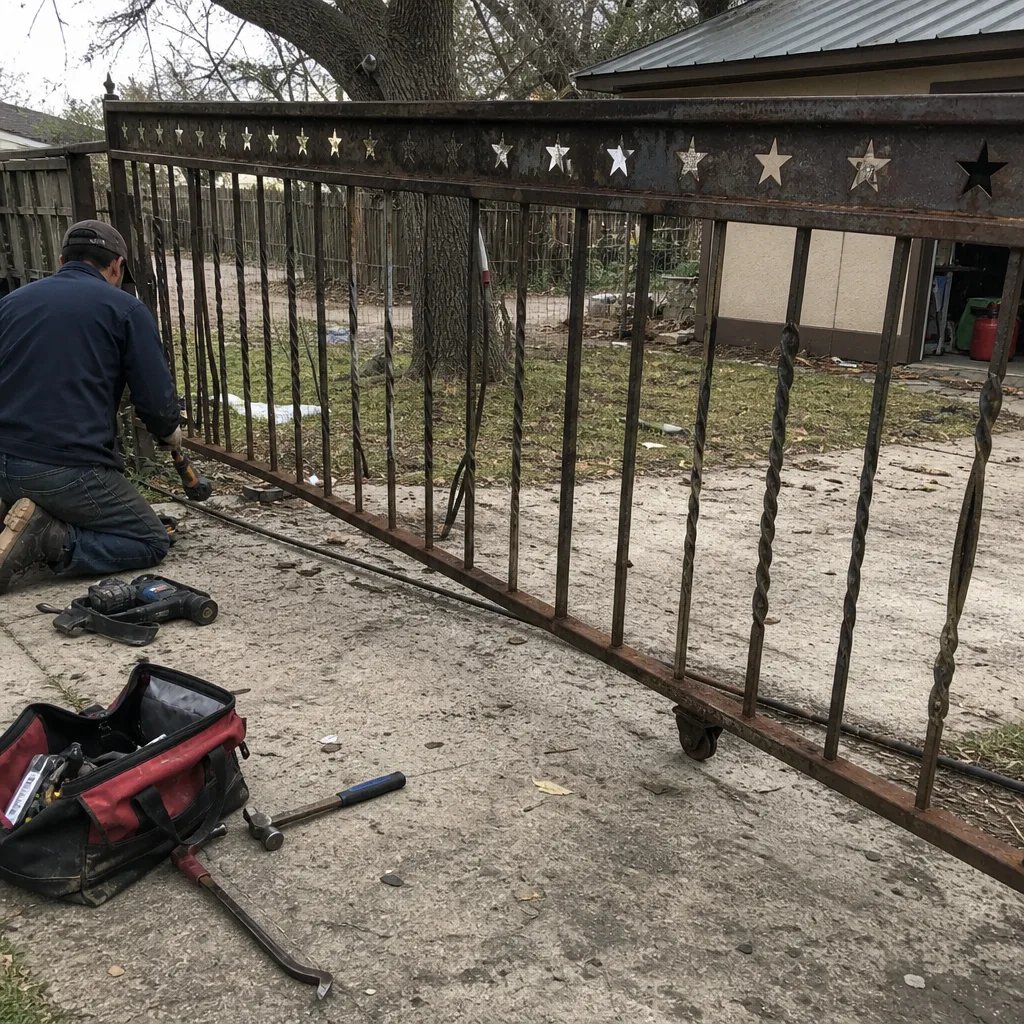 Before
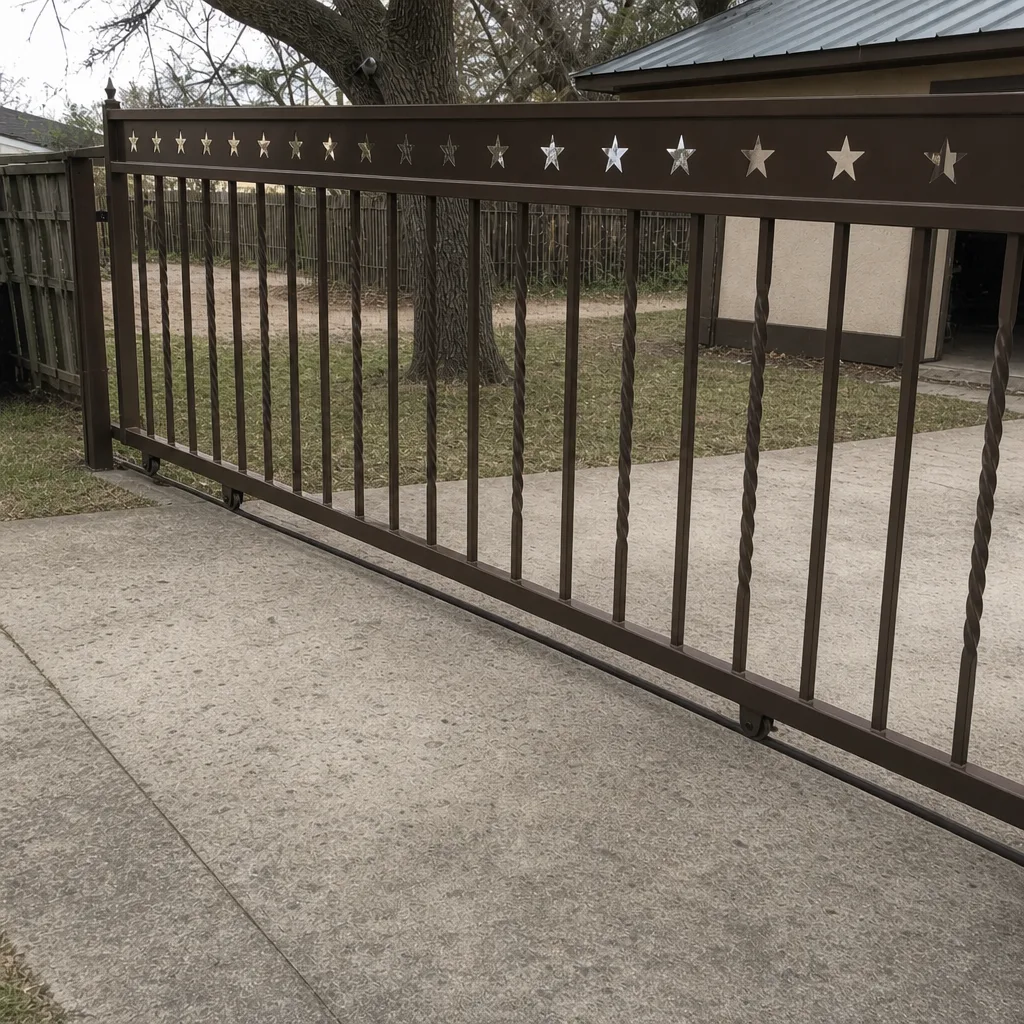 After
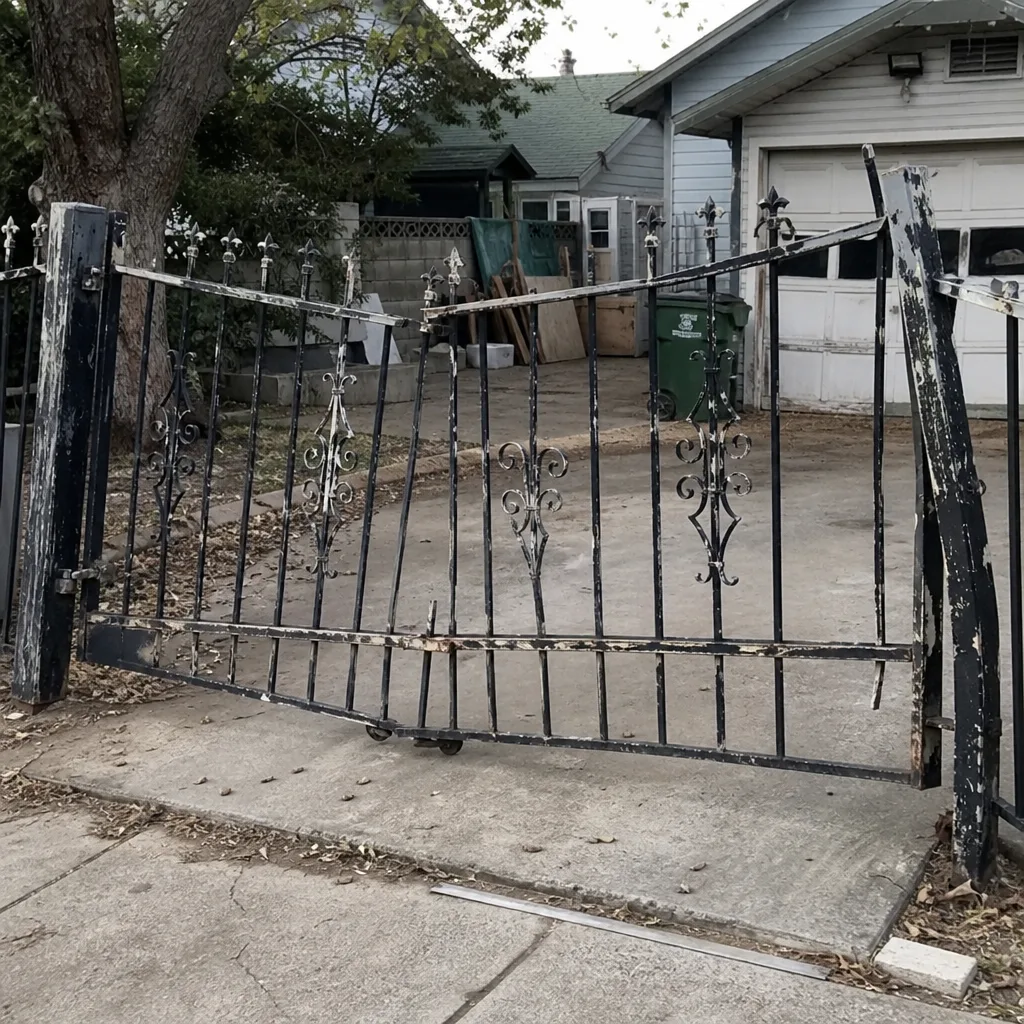 Before
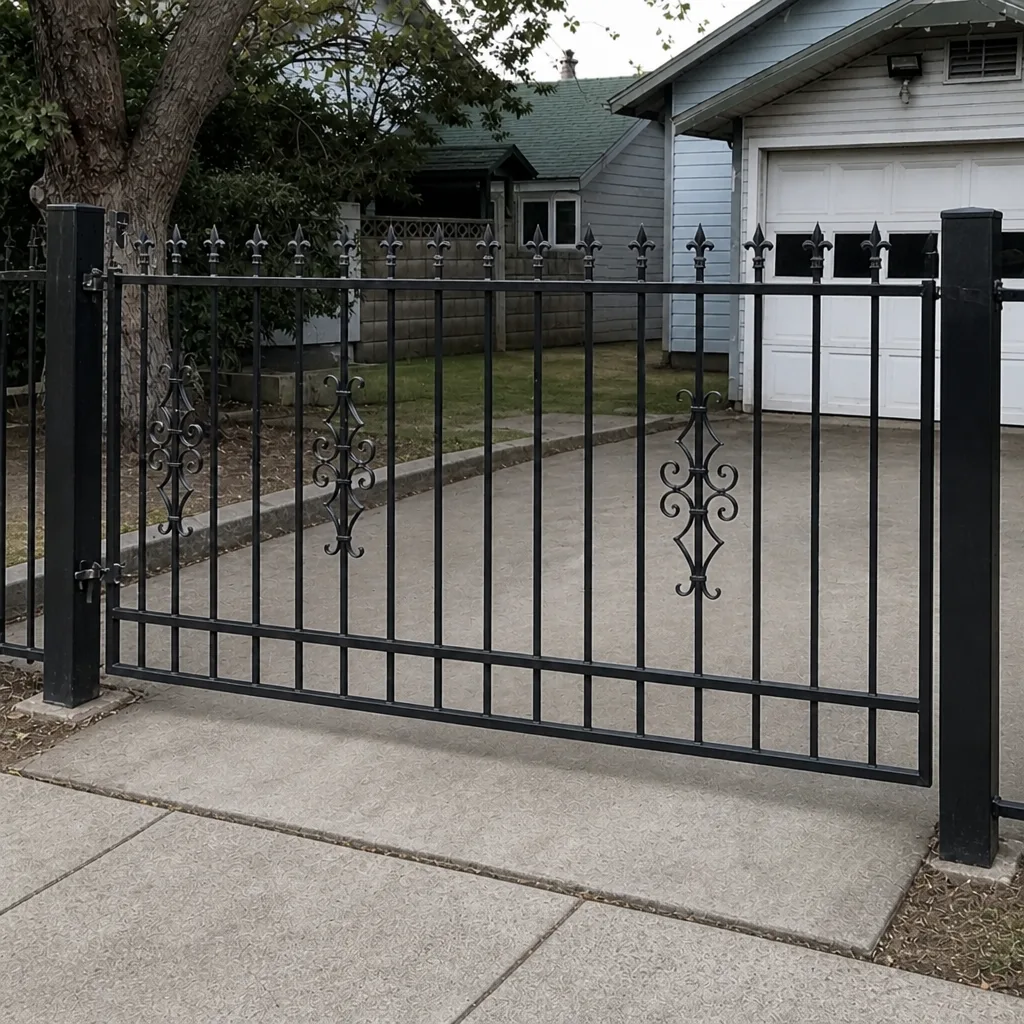 After
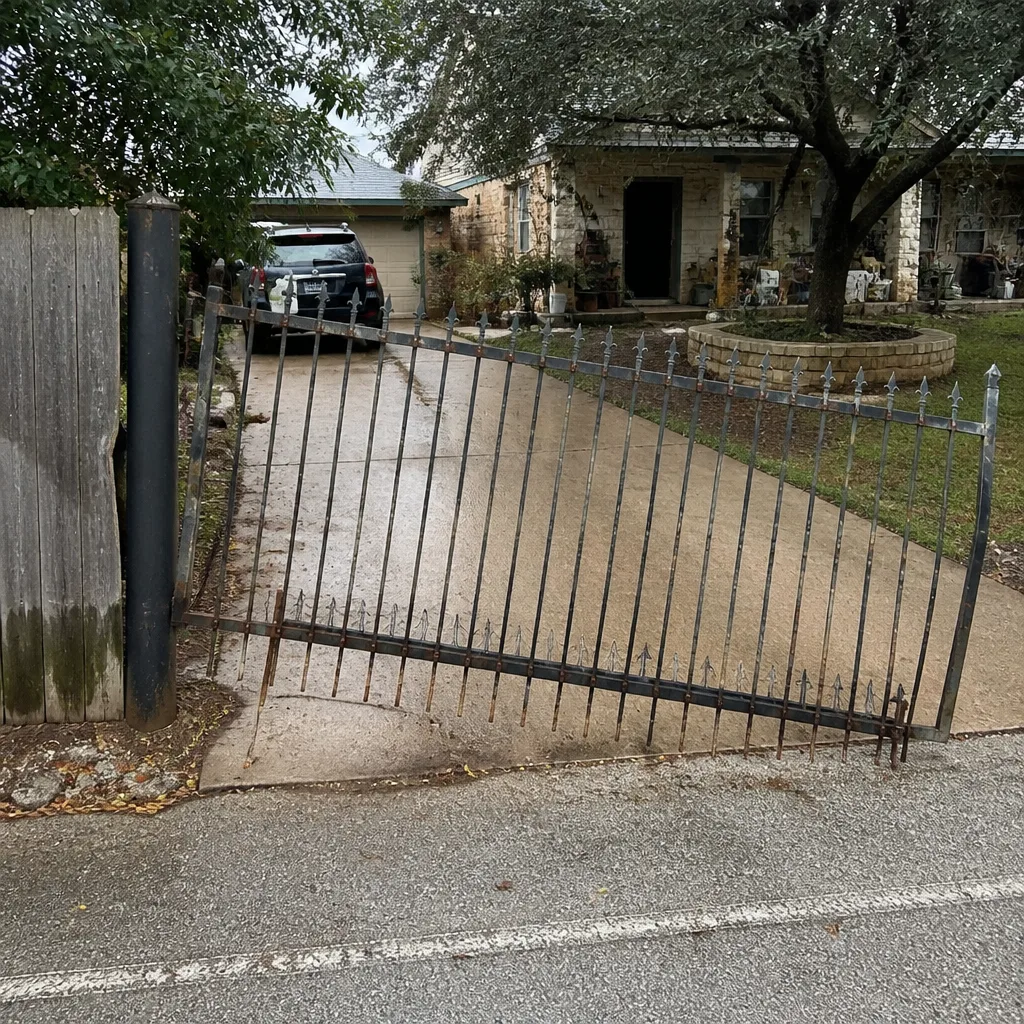 Before
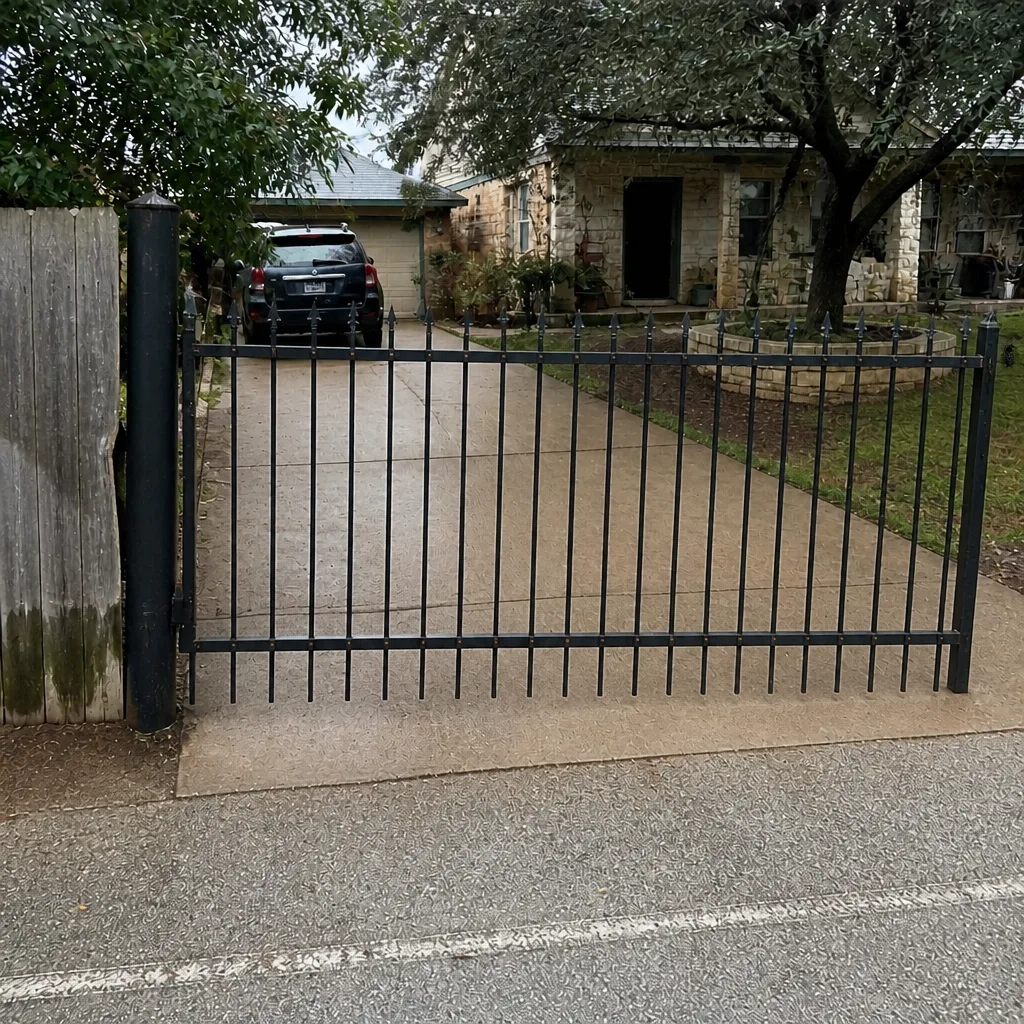 After
Frequently Asked Questions
Five items: a force test (gentle push against the moving gate), a visual obstruction scan of the travel path, a hinge fastener check, a wipe of the safety photo-eyes, and a battery backup voltage reading. All five take under 10 minutes and don’t require tools beyond a cloth and a multimeter. They catch the wear that leads to operator failure before it happens. If you’re not sure how to run any of them, call (855) 939-0250 for a free estimate on having the first check done by a technician.
Once a quarter for most residential gates. Clean the old grease and grit off first, then apply a lithium or synthetic gate grease. WD-40 isn’t a proper lubricant and should not replace grease on hinges or moving parts. If the gate gets heavy traffic or sits in direct sun, check the lube points between quarterly services. Call (855) 939-0250 if you’re unsure which lube points apply to your operator.
A trained gate technician should calibrate limit switches. The open and close limits have to match the physical gate travel; drifting limits cause slamming, hard stops, or the gate stopping mid-travel. Most modern operators need measured setup, not just a screwdriver turn. This is part of the annual service, and free estimates are available for it. Call (855) 939-0250.
Yes, and you should. Walk past a closing gate with your body just inside the sensor path and confirm the gate reverses. Wipe the lenses monthly with a dry cloth. If the gate fails to reverse, or if the photo-eyes lose alignment repeatedly, that’s a technician call. Call (855) 939-0250 for a free estimate.
Swing gates need hinge and footing attention most; slide gates need track cleaning and roller checks quarterly; barrier arms on commercial property need weekly checks because of high cycle counts. The monthly five-item check covers all three, but the quarterly and annual tasks differ. A technician can tell you which schedule fits your system in a single visit. Call (855) 939-0250 for a free estimate on the first service.
Yes. Monthly checks prevent most failures, but the annual service covers tasks that need tools and board knowledge – limit switch calibration, control board diagnostics, underground wire continuity, and footing inspection. That annual appointment is where a technician catches drift before it becomes a hardware failure. If you’re near New Braunfels, free estimates are available by calling (855) 939-0250.
The Bottom Line
Gate maintenance is a ladder, not a single service. The monthly five-item check – force test, visual scan, hinge fasteners, photo-eye wipe, battery voltage – is yours and takes 10 minutes. The quarterly rotation handles UV seals, proper lubrication, and track cleaning, which the Central Texas climate punishes more than most. The annual service is where a technician calibrates limits, reads the board, tests the buried wire, and inspects the footing. Keep a log of behavior so intermittent faults get diagnosed quickly. Avoid WD-40 as lubricant and skip no force test because the gate still moves. Whatever the brand, our gate specialists work on the system you already have. Written by the team at Gate Repair New Braunfels.
Contact Us
Whether the gate is running fine and you want a maintenance baseline or it’s making a sound you don’t recognize, we can take a look. Call (855) 939-0250 for a free estimate on gate repair or one of our annual service visits in New Braunfels. Our technicians have up to 14 years of experience, they work on the brand you already have, and the price is set per job by the written estimate before any work starts. We answer 24/7. Fast dispatch from 7am to 7pm, Sunday through Friday.
Written by the team at Gate Repair New Braunfels.