
FAAC Gate Repair in New Braunfels: A Homeowner’s Guide
FAAC operators have a reputation for near-indestructibility, so when one quits, most homeowners in New Braunfels assume it’s a minor fix. In reality, FAAC’s greatest strength – its integrated electronic control logic – is also the most common and most expensive failure point. This guide walks through what actually goes wrong on FAAC systems, from the 400 and 500 series that dominate local installs to the LED diagnostics that can tell you a lot before anyone touches a tool. If you’d rather skip the detective work, call (855) 939-0250 and we’ll take it from there.
We work on the brand you already have. Whether that’s a FAAC swing operator, a Ghost Controls DIY kit, or a DoorKing slide operator at a small commercial building, the diagnostic approach starts the same way: find the actual fault before replacing anything. FAAC is a specific case though, and it deserves its own guide.
Why FAAC Operators Are Overbuilt, and Why That Matters When They Fail
FAAC builds gate operators for commercial duty cycles and heavy access points across Europe and North America, then sells a residential segment that inherits much of that engineering. A typical residential FAAC arm or underground operator in New Braunfels is rated well beyond what a driveway gate will actually ask of it. That’s a good thing – until something goes wrong.
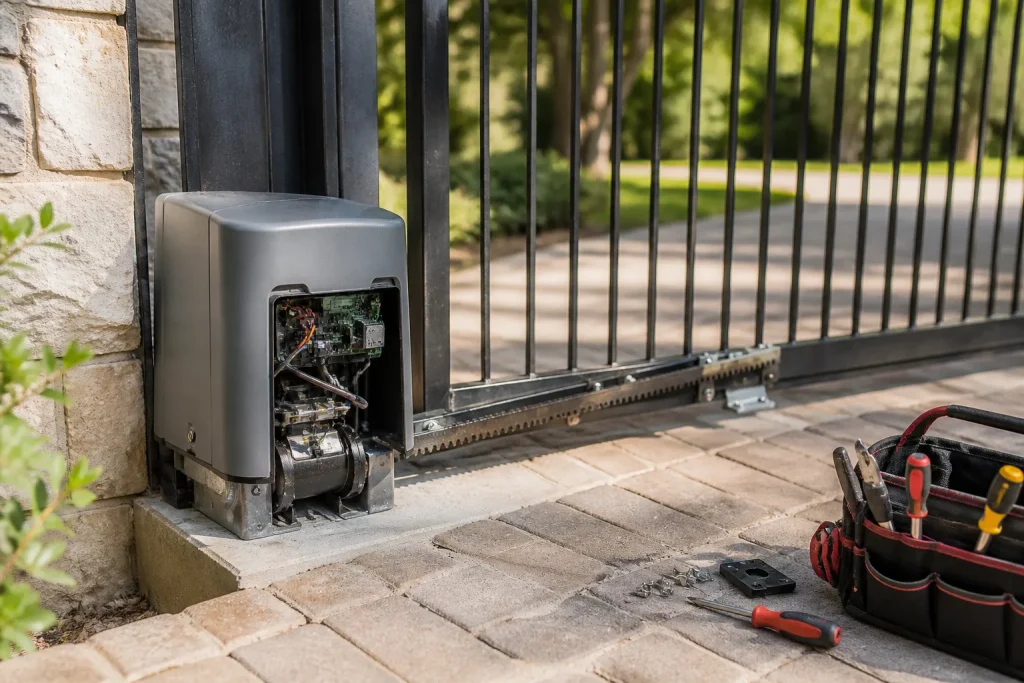
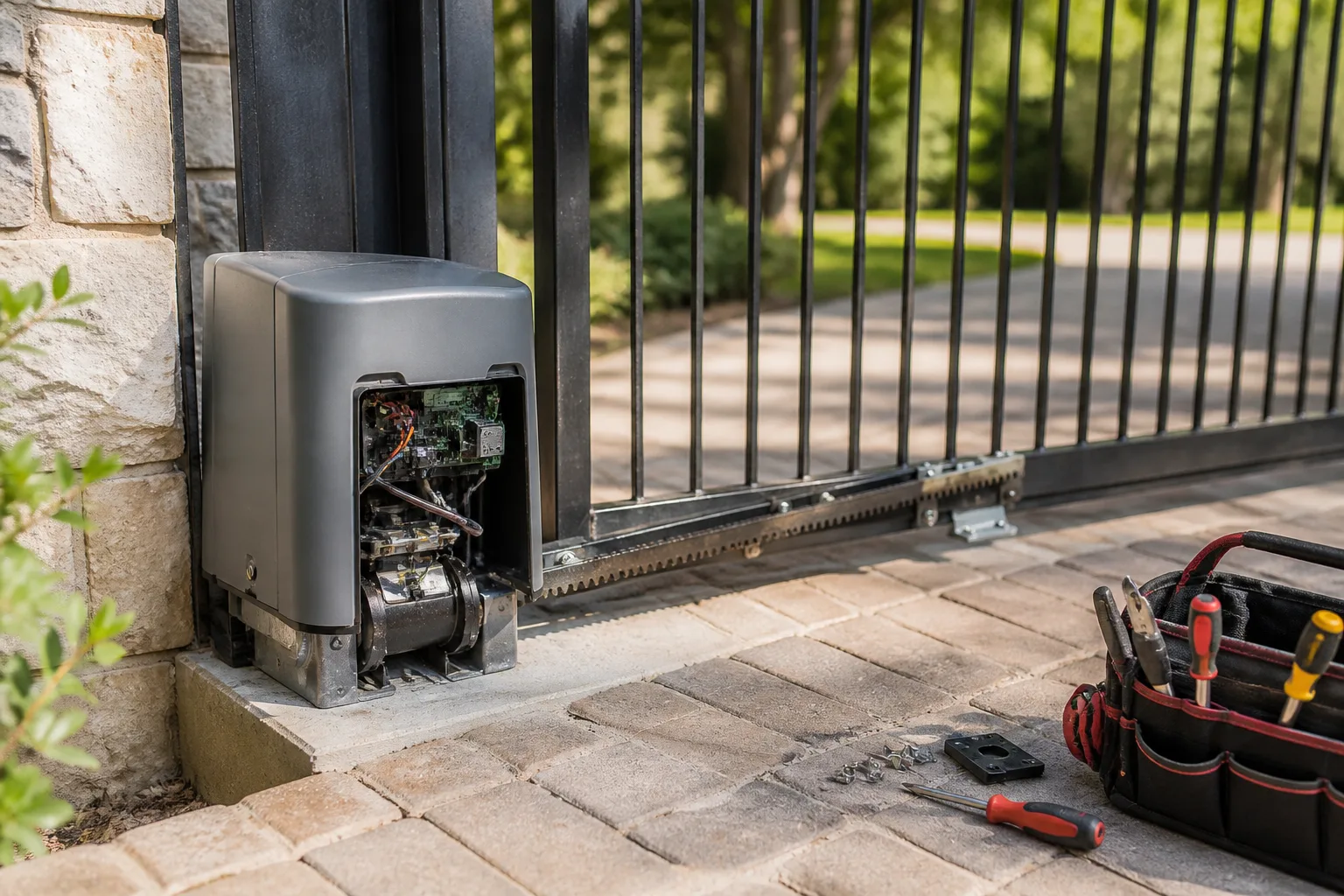
The core of a modern FAAC unit is its integrated control board, and that board handles far more than just “open” and “close.” It manages:
- Motor current draw and torque limits
- Encoder feedback for position tracking
- Obstruction detection on the closing path
- Soft-start and soft-stop ramps for the swing arm
- Safety edge and loop sensor inputs
Because all of those functions live on one board, the board itself is often the failure point. A power surge or a slow capacitor failure can take down a whole half of the control logic while the motor underneath still works fine. When a homeowner sees their gate stop, they usually picture a broken motor. In our experience on FAAC jobs in New Braunfels, the motor is often the last thing that’s actually wrong.
That matters for pricing and for expectations. An honest diagnosis of a FAAC system is a process, not a guess.
FAAC 400 and 500 Series: What Breaks Differently on Each
The 400 series and 500 series are the two FAAC families we see most often on residential driveways around New Braunfels, and their failure patterns are genuinely different. Treating them as interchangeable leads to misdiagnosis.
FAAC 400 Series (Swing Arm Operators)
The 400 series comes in several variants, but the common thread is an articulated swing arm driving an exterior-mounted motor unit. Failure modes we look for first:
- Arm and bracket wear: New Braunfels driveways see a lot of dust and grit that finds its way into the pivot points. Worn bushings throw off the encoder’s position reference and the board starts logging obstruction faults.
- Manual release lock: A sticky release key is one reason homeowners think the operator has failed when the gate won’t move manually. It hasn’t; the release is jammed.
- End-limit drift: The arm geometry shifts slightly as hardware wears, and the board loses track of where “closed” actually is. The gate stops short or reverses partway.
FAAC 500 Series (Underground and Ram Operators)
The 500 series is more often installed on heavier residential gates and small commercial entrances. Its failure profile is different because the operator is buried or heavily enclosed:
- Moisture intrusion: The underground casing needs proper drainage. In clay-heavy Central Texas soil, water pools in the box after a wet spring, and the board down there can fail before the motor does.
- Foundation shift: When the operator casing shifts slightly, the mechanical geometry between the arm and the gate changes, and the encoder sees obstruction that isn’t there.
- Heavier current draw: Ram and underground operators work harder per cycle. A failing capacitor shows up as a sluggish open rather than a hard failure.
Both families are repairable, and both benefit from a technician who knows which one they’re looking at before opening the case.
How to Read FAAC’s LED Diagnostics Before You Call
FAAC boards ship with onboard LED indicators, and those lights can tell you more in thirty seconds than most homeowner troubleshooting guides. You don’t need to touch anything dangerous to read them – just observe.
On most FAAC boards you’ll see a small cluster of LEDs. Typical ones you’ll find:
- Power LED: Solid means the board is receiving voltage. Off means no power – check the breaker and the fuse holder on the board itself before anything else.
- Status / diagnostics LED: Blinking patterns correspond to fault codes. The pattern (short blink, long blink, count of blinks) is documented in the manual for your specific FAAC model, and that’s the first place to look.
- Safety input LEDs: These show whether the board sees a closed circuit on your safety edges and photobeams. If a safety LED stays off when the gate is idle, the board thinks something is blocking the closing path and may refuse to close.
- Encoder LED: On boards that expose it, this one shows pulse activity as the gate moves. No pulses while the motor runs is one of the clearest encoder-fault signals.
Write down the blink count and the state of each LED before you call. That single act can save a technician a round of diagnostics, and any gate specialist will appreciate it. It also protects you – you’ll know whether the technician is actually following the diagnostic path or just skipping to “you need a new board.”
Encoder Faults: When Your FAAC Operator Isn’t Actually Dead
This is the single most common misdiagnosis we see on FAAC systems. The gate stops working, the motor hums or clicks and nothing happens. A generalist technician opens the case, sees the setup, and says “motor’s shot, needs replacement.” That’s often wrong.
FAAC uses a proprietary encoder system to track gate position. The encoder is what tells the board “the arm is here, we’re 40% open, keep going” or “we’re at the close limit, stop.” When the encoder signal is lost or corrupted, the board behaves exactly like a failed motor: the gate won’t move, or it moves a few inches and reverses, or it refuses to cycle at all.
Common causes of encoder problems on FAAC in New Braunfels:
- A failed encoder sensor or a damaged encoder disc
- Cracked or corroded encoder wiring near the pivot
- A board-side fault in the encoder input circuit
- Arm and bracket wear throwing off the physical reference the encoder was calibrated against
Each of those has a different fix. Wiring is cheap. Encoder sensor replacement is moderate. A board swap is the expensive answer – and it’s the wrong one if the encoder wiring was the actual problem. A technician who can test the encoder before condemning the board will sometimes save you hundreds of dollars.
Why Board Replacement on FAAC Systems Requires Careful Sourcing
FAAC control boards are proprietary, and that makes them a target for counterfeiters. If your FAAC board is genuinely dead, the replacement board is the single most important purchase you’ll make for the system, and it’s also the most easily gotten wrong.
Where FAAC boards should come from:
- Authorized FAAC distributors who can trace the board’s origin
- Reputable gate and access-control suppliers who will stand behind the part
- FAAC’s own parts channel through a dealer or installer
Where they should not come from:
- Generic marketplace sellers with no verifiable supplier
- Listings priced far below the market – the savings show up later
- Anything without a model plate that matches your existing board exactly
Counterfeit FAAC boards do one of two things: they fail fast, or they “work” until they don’t, often taking a motor or an encoder with them. A genuine board from a traceable channel costs more up front but is the only version of “cheap” that actually stays cheap.
If your FAAC system is original to a new build and you’re not sure which board version you have, open the operator case and read the model plate before ordering anything. Two FAAC boards that look identical from the outside are often not interchangeable.
What a FAAC Repair Should Actually Include
A proper FAAC repair looks different from a generic gate service call. We’d rather you know what to expect than be surprised when someone skips steps, so here’s the shape of a legitimate diagnostic and repair.
- Observe the fault before touching anything. LED states, blink codes, and the physical behavior of the gate all get written down first.
- Test the motor independently of the board. This separates a board fault from a motor fault from an encoder fault in a single step.
- Check the safety circuit. Photobeams, safety edges, and loop detectors get verified as functional before the board is judged. A stuck safety input mimics a board failure.
- Inspect the mechanical side. Arm pivots, brackets, hinge wear, and gate sag all affect the encoder reference and current draw. Mechanical faults look electrical and vice versa.
- Confirm the replacement part by plate. If a board or encoder is needed, the part number gets verified against the existing hardware before ordering.
- Re-learn the limits and test through a full cycle. A FAAC board isn’t “repaired” until it has learned the travel limits and completed several clean open/close cycles with the safety inputs live.
A technician who walks in, looks at the operator for a minute, and declares the board dead without running through these steps is guessing. We see the results of that guessing on FAAC systems in New Braunfels regularly, and the homeowner usually ends up paying for the board twice.
When to Call a Pro (and What to Do Before You Do)
Some FAAC troubleshooting is safe and useful to do yourself: reading the LEDs, checking the breaker, verifying the manual release isn’t jammed, and confirming nothing is physically blocking the gate. Those four checks take five minutes and rule out a surprising number of “failures.”
Other things are not safe. The operator’s wiring carries household line voltage, and the interior of an underground casing or a ram operator can hold stored energy and moving parts that don’t announce themselves. Do not open a live operator case, do not probe board terminals with a multimeter on power, and do not attempt to bypass a safety input to make a gate close. Call a gate technician for anything past the LED check.
Related services in New Braunfels: if the FAAC operator turns out to be beyond economical repair, we also handle electric gate repair across the other major brands and full new gate installation, so you’re not left needing a second contractor to close out the job. If you want the broader version of this conversation, see our gate repair overview, and for the surrounding area, New Braunfels.
The Bottom Line
FAAC operators are good hardware. The failures that bring them down are more often electronic than mechanical, more often board or encoder than motor, and more often diagnosable than a generalist will admit. If your FAAC gate has stopped in New Braunfels, the sequence to follow is straightforward: read the LED blink code, check the manual release, note the safeties, and then get a technician who knows the FAAC platform to test the encoder before anyone sells you a board.
- Read the diagnostics before touching anything
- Suspect encoder and safety inputs before motor failure
- Source any replacement board through a traceable FAAC channel
- Demand a diagnostic sequence, not a replacement quote
We work on the brand you already have, and our technicians have up to 14 years of experience across FAAC, LiftMaster, BFT, Linear, Viking, Ghost Controls, DoorKing, Elite, and Mighty Mule systems. If you want help, we can also look at a Ghost Controls or Elite unit on the same visit if you’ve got one on the property – saves everyone a trip. Our technicians handle both the mechanical and control/electrical sides, so the diagnosis stays in one place.
If you’re in New Braunfels and need help, Gate Repair New Braunfels offers free estimates – call (855) 939-0250. We answer 24/7. Fast dispatch from 7am to 7pm, Sunday through Friday. Every repair is priced per job by a written estimate, agreed before any work starts, so what we quote is what you pay.
Frequently Asked Questions
FAAC repair costs depend on what’s actually failed – an encoder wiring repair and a full board replacement are very different jobs. Every repair is priced per job by a written estimate after we test the system, and the written estimate is what you pay. Call (855) 939-0250 for an exact quote; estimates are free.
Often, yes. Many FAAC faults come down to encoder wiring, safety inputs, or limit re-learning that can be handled on the first visit. Board replacements may need a part sourced through a FAAC channel, which can add a return trip. Call (855) 939-0250 and we’ll book you in – fast dispatch from 7am to 7pm, Sunday through Friday.
The LED indicators on the FAAC board usually give it away: an encoder fault shows up as a missing or irregular pulse signal while the motor still runs, while a motor failure usually means the motor doesn’t turn at all. A technician confirms it with a direct motor test before ordering parts. Call (855) 939-0250 for a diagnostic visit.
Only through an authorized FAAC distributor or a reputable gate supplier who can trace the part. Counterfeit FAAC boards sold through marketplaces often fail fast or damage surrounding components when they do, and the original repair ends up costing more. If you’re not sure of your board version, call (855) 939-0250 – we can confirm the model plate before anything is ordered.
Gate repair New Braunfels – if this guide helped you understand your FAAC system, our gate specialists can take it from the diagnostic to the fix. Call (855) 939-0250 for a free estimate.
Written by the team at Gate Repair New Braunfels.
Need Gate Repair Help?
Call Gate Repair New Braunfels - licensed & insured, here with fast help in New Braunfels.
(855) 939-0250